Industrial Products



TG LATP Solid Electrolyte
Next-generation oxide solid electrolyte that satisfies both safety and cost-effectiveness
FOR YOUR
DREAM
Liquid electrolytes face thermal-runaway risks and energy-density limits, while sulfide electrolytes are difficult to commercialize due to extreme manufacturing requirements and very high costs. The only commercially viable answer that satisfies safety, process compatibility and cost-effectiveness at the same time is the oxide solid electrolyte.
divider
Product Overview
- High ionic conductivity
- Excellent stability
- Optimal for ESS: compatible with high-voltage cathodes
- Low manufacturing cost
- Suitable for large-scale mass production
Structure & Mechanism
■ Structural definition
Lithium aluminum titanium phosphate (chemical formula: Li₁₊ₓAlₓTi₂₋ₓ(PO₄)₃, LATP) is an oxide-based ceramic solid electrolyte belonging to the NASICON (Natrium Super Ionic Conductor) structural family.
■ Ion-conduction mechanism
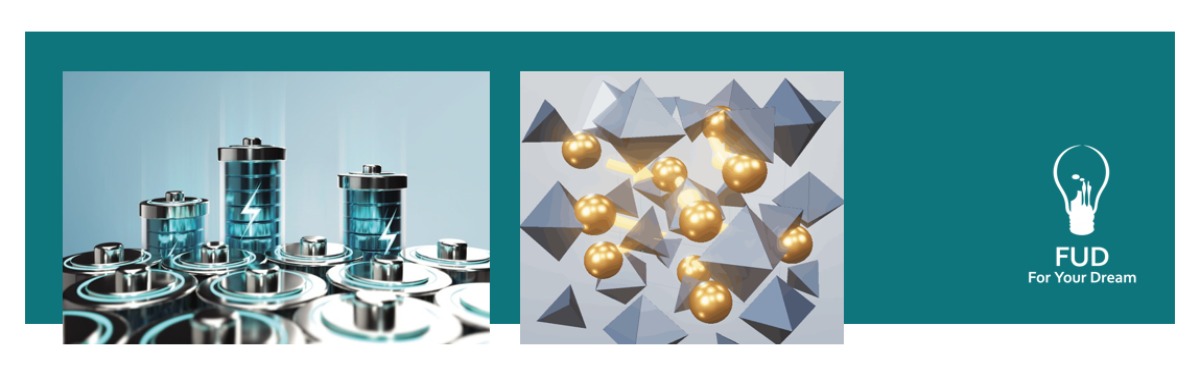
In LATP, PO₄ tetrahedra and TiO₆ octahedra share corners to form a robust three-dimensional framework. This open framework provides continuous 3D ion-transport channels, enabling fast diffusion and migration of lithium ions.
■ Core competitiveness
This unique crystal structure is regarded as the fundamental basis that allows LATP to achieve high ionic conductivity.
divider
Competitive Comparison
| Competitor LATP | Comparison Item | TG-LATP | Key Advantage |
| 3.5 X 10⁻⁴ | Room-temp. Li-ion conductivity (S/cm) | 5.8 × 10⁻⁴ (approx. 2x competitors) |
Approx. twice the ionic conductivity of competitors, lowering internal resistance and improving fast charge/discharge. |
| Industrial-grade TiO₂ + standard formulation |
Key titanium material | ✔ Modified TiO₂ + composite formulation |
A structure that lowers Li⁺ migration or activation energy, improving stability and conductivity simultaneously. |
| 4.0~4.5 | Electrochemical stability window (V vs. Li/Li⁺) | ≥ 4.8 | Compatible with high-voltage cathodes above 4.8 V, suitable for next-generation high-energy-density cell designs. |
| 0.35~0.40 | Activation energy (eV) | ≤ 0.32 | Low activation energy facilitates ion transport even at low temperatures. |

